About Bujinkan Gray Dōjō
From Japan, Around the Globe, to New Zealand
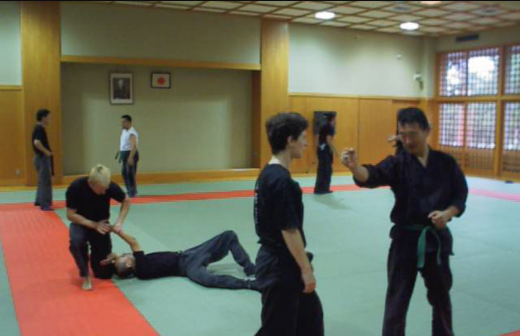
Saturday class in Ibaraki, circa 2003
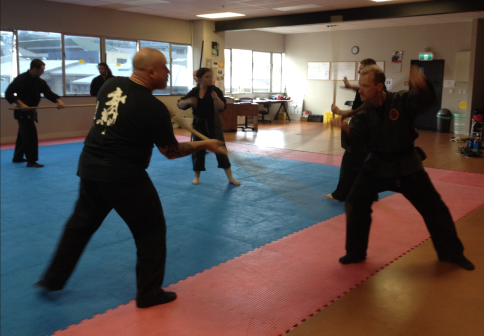
20th Anniversary Seminar in Wellington

Bujinkan Gray Dōjō was founded in Ibaraki, Japan on July 1, 2000 with the blessing of Hatsumi Sensei and Shiraishi Sensei, becoming the first Bujinkan Dōjō in Japan to be established by a non-Japanese civilian. Our Dōjō originally functioned as a Saturday morning training lab in which we worked on material that was being taught by Hatsumi Sensei that week. In addition to our own Dōjō membership (comprised of Japanese and foreign ex-pats) we were frequently blessed to have senior students of Shiraishi Sensei and Noguchi Sensei assist with instruction.

In the time since, Shawn has frequently been invited to give training workshops overseas, often venturing abroad from Japan to teach several times a year. These "martial pilgrimages" have been wonderful training experiences of sharing the feeling of many years of training in Japan with others. The international nature of the Bujinkan is one of its greatest strengths, and we are eternally grateful to Hatsumi Sensei for providing an environment that makes this international exchange possible.

After moving from Japan to New Zealand in 2014, Shawn began offering regular classes in the Wellington Region. It's been exciting to see the group evolve with first-time beginners as well as others who have had prior experience in the Bujinkan and other martial arts. Hatsumi Sensei has remarked a number of times at how good people are attracted to my Dōjō, and it's been good to see that this is the case here in New Zealand as well. We'd love to hear from you if Bujinkan training sounds like it might be of interest.
Get in touch to check out our classes in the Wairarapa!

About Bujinkan Budō Taijutsu
The Organization and the Art
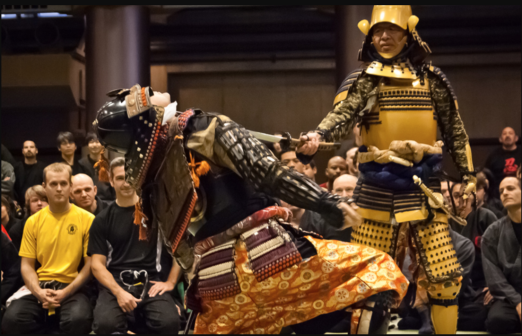
Hatsumi Sōke demonstrates use of Japanese armour ("Yoroi", 鎧).
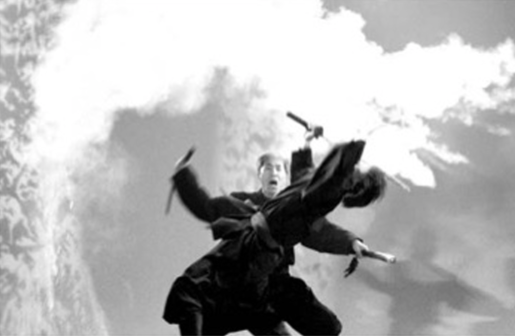
No rules means expect the unexpected!

The Bujinkan organization was formed in the early 1970's as the umbrella organization under which Hatsumi Masaaki Sōke ("Grandmaster") transmits the teachings of the martial arts Ryū-ha ("traditions" / "schools") which he in turn received from his teacher, Takamatsu Toshitsugu Sōke. These Ryū-ha follow an unbroken lineage back through hundreds of years of Japanese history. The roots of the Ryū-ha themselves are said to be 3,000 years old.

Although Hatsumi Sensei possesses Denshō ("scrolls") which designate him as the Sōke of many different Ryū-ha, the Bujinkan itself is officially comprised of the following 9 Ryū-ha:

Ryū-ha Name Meaning Founding Year
Gyokkō Ryū Jade Tiger School 1207
Kotō Ryū Tiger-felling School 1542
Takagi Yoshin Ryū Takagi Raise-the-Heart School early 1600s
Shinden Fudō Ryū Divine Transmission Immovable School early 1300s
Gikan Ryū Regard for Justice School 1558-1570
Kukishinden Ryū Kuki Divine Transmission School 1330
Gyokushin Ryū Jade Heart School mid 1500s
Kumogakure Ryū Concealing Clouds School mid 1500s
Togakure Ryū Concealing Door School 1162

These Ryū-ha were formed during the centuries of civil war which preceded the unification of Japan under the Tokugawa Shogunate in 1603. Their teachings have not been watered down for the sake of sporting applications, as is the case with most other Japanese martial practices, but have been faithfully handed down as methods for dealing with real-life conflict-resolution situations. As these teachings have been tested on the battlefield, they are well-suited to self-defense situations where there is no ring and no rules.

With no rules, there are no rule-based competitions such as tournaments or other such sporting events in the Bujinkan. Training is mainly done through study and practice of various scenarios involving 1 or more opponents, either empty-handed or with a variety of tools. Training is done in a safe and controlled manner, at a level of intensity that training partners are comfortable with.

Although there are "no rules" in a fight, there are rules in organisations, and the Bujinkan is no exception to this. The Bujinkan Guidelines outline the regulations and standards of conduct which all members are expected to follow.